Showing posts with label GENITAL MUTILATION. Show all posts

Sunday, July 25, 2010

FGM

Female circumcision will be inflicted on up to 2,000 British schoolgirls during the summer holidays – leaving brutal physical and emotional scars. Yet there have been no prosecutions against the practice

Like any 12-year-old, Jamelia was excited at the prospect of a plane journey and a long summer holiday in the sun. An avid reader, she had filled her suitcases with books and was reading Harry Potter and the Prisoner of Azkaban when her mother came for her. “She said, ‘You know it’s going to be today?’ I didn’t know exactly what it would entail but I knew something was going to be cut. I was made to believe it was genuinely part of our religion.”

She went on: “I came to the living room and there were loads of women. I later found out it was to hold me down, they bring lots of women to hold the girl down. I thought I was going to be brave so I didn’t really need that. I just lay down and I remember looking at the ceiling and staring at the fan.

“I don’t remember screaming, I remember the ridiculous amount of pain, I remember the blood everywhere, one of the maids, I actually saw her pick up the bit of flesh that they cut away ’cause she was mopping up the blood. There was blood everywhere.”

Some 500 to 2,000 British schoolgirls will be genitally mutilated over the summer holidays. Some will be taken abroad, others will be “cut” or circumcised and sewn closed here in the UK by women already living here or who are flown in and brought to “cutting parties” for a few girls at a time in a cost-saving exercise.

Then the girls will return to their schools and try to get on with their lives, scarred mentally and physically by female genital mutilation (FGM), a practice that serves as a social and cultural bonding exercise and, among those who are stitched up, to ensure that chastity can be proved to a future husband.

Even girls who suffer less extreme forms of FGM are unlikely to be promiscuous. One study among Egyptian women found 50% of women who had undergone FGM “endured” rather than enjoyed sex.

Cleanliness, neatness of appearance and the increased sexual pleasure for the man are all motivations for the practice. But the desire to conform to tradition is the most powerful motive. The rite of passage, condemned by many Islamic scholars, predates both the Koran and the Bible and possibly even Judaism, appearing in the 2nd century BC.

Although unable to give consent, many girls are compliant when they have the prodecure carried out, believing they will be outcasts if they are not cut. The mothers believe they are doing the best for their daughters. Few have any idea of the lifetime of hurt it can involve or the medical implications.

Jamelia, now 20, who says her whole personality changed afterwards.”I felt a lot older. It was odd because nobody says this is a secret, keep your mouth shut but that’s the message you get loud and clear.” She stopped the sports and swimming she used to love and became “strangely disconnected with her own body”. Other girls have died, of shock or blood loss; some have picked up infections from dirty tools. Jamelia’s mother paid extra for the woman to use a clean razor. It is thought that in the UK there are one or two doctors who can be bribed by the very rich to to carry out FGM using anaesthetic and sterilised instruments.

Comfort Momoh works at Guy’s and St Thomas’ Hospital in London, in one of the 16 clinics up and down the country who deal with FGM and its health repercusssions. Women who have had much of their external genitalia sliced off and their vaginas stitched closed, but for a tiny hole, also come to be cut open in order to give birth.

There are four types of female circumcision identified by the World Health Organisation, ranging from partial to total removal of the external female genitalia. Some 140 million women worldwide have been subjected to FGM and an estimated further two million are at risk every year. Most live in 28 African countries while others are in Yemen, Kurdistan, the US, Saudi Arabia, Australia and Canada.

The UK Prohibition of Female Circumcision Act 1985 makes it an offence to carry out FGM or to aid, abet or procure the service of another person. The Female Genital Mutilation Act 2003, makes it against the law for FGM to be performed anywhere in the world on UK permanent residents of any age and carries a maximum sentence of 14 years imprisonment. To date, no prosecutions have been made under UK legislation.

“Obviously in summer we get really anxious. All activists and professionals working around FGM get anxious because this is the time that families take their children back home. This is the time when all the professionals need to be really alert,” said Momoh.

“There is no hard evidence in figures about what is happening in the UK because it’s a hush-hush thing. It’s only now that a few people are beginning to talk about it, which is good because change will only come from within and the numbers coming forward are rising. But there is a lot of family pressure. When I first started in 1997 we had two clinics in the country, now we have 16.”

One woman told the Observer how a midwife examining her had raced retching and crying from the room. She had no idea she was “abnormal” before that happened. There is a clear need for women who have suffered FGM to be able to visit health professionals who understand what has happened to them. Momoh said that for those who wanted it, some surgical reversal work could sometimes be done on women with the most severe FGM procedure, Type III. For those with other types, counselling and support is all that can offered.

“Periods are agony – you get a lot of women who are determined to have reversals while they are having their period but then when the pain has stopped they lose their nerve again,” said Leyla Hussein, 29, who has had to have years of counselling to cope with her own anger and distress at what was done to her as a child. It has helped her forgive her own mother’s complicity in the mutilation she endured, though the older woman could not understand why Hussein would not have her own child, now aged seven, cut. But Hussein has vowed that she will be the last generation of women in her family to suffer.

“It was my husband who said on our honeymoon, ‘We are not going to do this thing to any child of ours.’ I was quite shocked, I hadn’t questioned it. But I now realise a lot of men are not in favour of FGM, not when you tell them the woman is not going to enjoy herself.”

Hussein is among a slowly but steadily growing band of women who have reacted against what happened to them with courage and a determination to stamp out FGM. Hussein has run support and discussion groups for affected women and for men, and formerly worked at the African Well Women’s Centre in Leyton, east London.

“I can really relate to some of the women who are very angry, but how do you blame your mother, who loves you yet planned this for you? There is a lot of anger and resentment. Many women blame themselves and of course there are flashbacks to deal with. I had blackouts – anytime I had to have a smear test, I would pass out because lying in that position brought it back to me, but the nurse is used to me now and allows a little more time with the appointment.”

“The new generation, born and raised here in Britain, they are used to expressing their views and it will be a lot harder to shut them up. Last month was the first ever march against FGM [in Bristol where 15 to 16 mothers protested] and that is a sign of something new.”

Asha-Kin Duale is a community partnership adviser in Camden, London. She talks to schools and to families about safeguarding children. “Culture has positive and negative issues for every immigrant community. We value some traditions, and most are largely good.

“FGM is not confined to African countries. It has no basis in Christianity, it has no basis in Islam; none of Muhammad’s daughters had it done. For some parents it is enough to let them know that and they will drop it completely. Everyone needs to understand that every child, no matter what the background or creed, is protected by this law in this land.”

She said there needed to be an understanding of why FGM took place, although that was not the same as accepting that the practice had a cultural justification.

“FGM has a social function and until this is understood by social services and other bodies they will never stop it. It is a power negotiation mechanism, that women use to ensure respect from men. It prevents rape of daughters and is a social tool to allow women to regain some power in patriarchal societies. With girls living in the UK there is no need to gain the power – it has to be understood that girls can be good girls without FGM.”

For Jason Morgan, a detective constable in the Met’s FGM unit, Project Azure, the solution lies with those girls themselves: “Empowering youth, giving them the information, is the way forward. They are coming from predominantly caring and loving families, who genuinely believe this is the right thing to do. Many are under a great deal of pressure from the extended families.

“Sometimes it might be as simple as delivering the message of what the legal position is; sometimes we even give them an official letter, a document that they can show to the extended family that states quite firmly what will happen if the procedure goes ahead. The focus has to be on prevention.”

Project Azure made 38 interventions in 2008, 59 in 2009 and 25 so far this year. For Morgan those statistics are just as important as getting a conviction. “We know it happens here although we have no official statistics, but we have seen very successful partnerships and we don’t want to alienate communities through heavy-handed tactics.

“While a prosecution would send out a very clear message to practising communities, really it is very difficult and you would be relying on medical evidence, and in turn that would all hinge or whether the child consents to an examination.”

But Naana Otoo-Oyortey is not so content with the softly-softly approach: “We have anecdotal evidence that it is being done here. So someone is not doing their job: it’s an indication that the government has been failing to protect children. The commitment is hollow.”

Head of the leading anti-FGM charity Forward UK, Otoo-Oyortey said people value the FGM tradition as something which holds a community together and gives it structure. “It’s seen as a party, a cutting party because it’s a celebration – people expect it as a way of welcoming a girl. A lot of women will mention to us that there have been no prosecutions here so why do we worry about the law? At the end of the day who will know?

“And we cannot just blame the women as the men are silently supporting it by paying for it. The new government’s lack of a position on FGM is very worrying. We don’t know what they will do, but we do know that the summer holidays are here again and we will be left to pick up the pieces in a few weeks’ time.”

And for those who will be “cut” this summer, the effects will be lifelong. Miriam was six when she had her cutting party at her home in Somalia, two years before war arrived to force her family out.

When she was 12, doctors were horrified to find that what they thought was a cyst in her body was actually several years of period blood that had been blocked from leaving her body. Unable to have children, she now lives and works in England and worries about other girls. “I’d seen so many people circumcised, all my neighbours, so I knew one day it was going to happen to me. We knew what was happening,” Miriam said.

“The little girls who were born in Europe have no clue. They will be traumatised a lot more. The only thing they know is that they are going away – that’s what they say, ‘We’re going on a holiday’.

“Then her life and her head are going to be messed up. It’s amazing how many people are in mental health care because of their culture. Don’t get me wrong, I have religion and culture and I love where I’m from and I love what I stand for. But culture should not be about torture.

“Why would anyone want to go and cut up a seven- or eight-year-old child? People need to wake up — you are hurting your child, you are hurting your daughter, you’re not going to have a grandchild, so wake up.”


http://www.guardian.co.uk/society/2010/jul/25/female-circumcision-children-british-law

Saturday, July 24, 2010

12 reasons not to cut your son

I have never understood why circumcision is a common practice in North America today (though I’m a woman; what do I know?) From what I gather, apart from religious reasons or making the penis look “prettier” there really doesn’t seem to be ANY good reason for it.

My husband and I decided to not circumcise our son, and for a good reason! There are a lot of myths about the benefits of circumcision and there are a lot of health risks involved in the procedure. Topping our list of why we said “no” to circumcision is:

If you’re born with it, it’s meant to be there

The foreskin on a penis isn’t some sort of optional part that was put there for fun – it actually has an important function! Babies need foreskin to protect the “glans” (the part of the penis that is in the foreskin) from bacteria and infections – like the kind of infections that can be caused by a diaper full of pee and poop.

It hurts your baby

Don’t be fooled; those who tell you your baby will not remember the pain you made him suffer through or isn’t old enough to even know what pain is are pleading ignorance. How would you like to be strapped to a board and have a chunk of skin lobbed off with a tool similar to a cigar cutter? The anesthetic used to numb the area is unsafe for your baby. Because of this, it is given in a reduced quantity (so it isn’t really doing a fantastic job when numbing) and it wears off rather quickly. Let’s see… open wound rubbing on a diaper 24 hours a day. Doesn’t sound very pleasant to me.

No one approves of circumcision

It’s true: no medical institution in the world thinks that circumcision is a good idea. Babies actually can die during the process (about 18 out of 100,000)

You are taking away your son’s rights

Your son didn’t ask for you to remove a vital part of his body. Parents make the decision to put their child through this unnecessary pain without even consulting the patient. If my son wants to circumcise himself when he’s old enough, then that’s his choice; not mine.

It’s a traumatic event

I was surprised to find out that circumcision can affect breastfeeding, sleep, and even maternal bonding. Studies have also indicated that men who are circumcised have a lower pain threshold and suffer from Post Traumatic Stress Disorder symptoms.

Circumcision is SO passé

As we move further and further away from the 1970s, the circumcision rates continue to move on a steady decline. Even those of the Jewish faith are performing circumcision alternatives so that their child is not actually cut (referred to as the “Brit Shalom”).

Circumcision is a big business

Did you know that every single State could save up to $1 million a year if they did not fund these unnecessary circumcisions? Several States and insurance companies have ceased funding this practice.

What about urinary tract infections (UTIs)?

There are some unfounded rumors out there stating that uncircumcised boys suffer from UTIs, but that simply is not true. If your son does happen to have a UTI, antibiotics, breastfeeding and proper cleaning work wonders for curing and preventing it.

It’s not a cancer preventative

Out of all men who suffer from a penile cancer, those with an uncircumcised penis only showed a 0.2% increased risk. Circumcision is not the answer for treating genital cancers, though not smoking and having protected sex is.

It won’t necessarily reduce the risk of AIDS

Yes, there have been studies performed in Africa which correlate circumcision with the reduced contraction of AIDS. However, these studies have not yielded the same results in the United States. Safe sex and cleanliness are more effective measures in keeping yourself free from sexual transmitted diseases.

It IS easy to clean

The foreskin is there naturally and has a self-cleaning “mechanism”, much like a female’s vagina does. You should not retract the skin (especially infants and children) until it is easily retractable. All children need is a good warm bath to keep it clean

Father knows best?

This is one of the most ridiculous arguments I’ve heard – “I needed to circumcise my son so he looks like his father!” Right. And should mom grow a penis so that she looks like her son too? Take this as an opportunity to explain how everyone’s body is different, unique and beautiful.

http://www.naturalfamilyonline.com/go/index.php/15/12-no-to-circumcision

Friday, July 23, 2010

Circumcision as a Memeplex

- talk by Hugh Young
at the Eighth International Symposium on Circumcision and Human Rights,
Padova, Italy, September 3, 2004

A meme is "a unit of cultural transmission, or a unit of imitation"

- Richard Dawkins

Common examples of memes are

  • tunes, like "Happy Birthday to You" or your national anthem (four notes is thought to be the minimum)
  • catchphrases, like "Like father, like son" or "blood, sweat and tears"
  • myths, like George Washington chopping down the cherry tree, or the tooth fairy
  • folk beliefs, like "We only use 10% of our brains" and
  • customs, like tossing spilt salt over your left shoulder and genital mutilation.

(Dawkins cites “tunes, ideas, catch-phrases, clothes fashions, ways of making pots or of building arches”.)

A cluster of related memes is a memeplex. (Dawkins called it a “co-adapted meme-complex”, but the name of the meme has evolved.)

Examples of memeplexes are

  • languages, and subsystems of languages such as alphabets, fonts, dialects and regional accents
  • clusters of customs, such as Christmas celebrations
  • systems of thought, such as philosophies and religions [except our own, of course]

Memes, like genes, are replicators - they copy themselves - an amazing property, when you think about it, the basis of life itself.

Like genes, memes endure and copy themselves with variations, which are naturally selected, and thereby evolve. Like genes, they are "selfish" - or rather, their function is the promotion of their own survival.

...all that counts in the life of a meme is whether or not it survives and replicates. ... we must remember that [saying that memes 'want', 'need', or 'try to do' something] is only shorthand for saying that the 'something' will improve the chances of the meme's being copied. Memes do not have conscious intentions; nor do they actually strive to do anything at all. They are simply (by definition) capable of being copied, and all their apparent striving and intentionality comes from this.

- The Meme Machine, p 162

Unlike genes, only human (and possibly some primate, and electronic) brains carry memes.

A good analogy for a meme today is a computer virus. In fact, a computer virus, being merely information stored in, and transmitted between, information processsing systems, is more like a meme than it is like a biological virus (which is a self-contained physical entity that actually moves between organisms, carrying genetic information with it).

Richard Dawkins says that as with genes, we track memes through populations by their phenotypes [ways of being physically expressed]. And he cites circumcision as a rare example of a meme phenotype that is part of a living body, like most gene phenotypes. He says a Martian geneticist ... … would have to work quite hard to discover that no genes are involved in the genesis of the "roundhead" (circumcised) phenotype.

Susan Blackmore suggests that the taboo on masturbation, and circumcision, both have the evolutionary function of increasing the amount of vaginal sex, and hence the number of offspring to whom the taboo can be taught. Enter evolutionary biology. But there is no evidence that circumcision significantly increases the birthrate, and many circumcised men claim circumcision does not make masturbation more difficult.

But the belief that it did was sufficient to establish it in the UK and then the US, late in the 19th century, and once established, it sustained (and sustains) itself by associated memes that had (and have) nothing to do with masturbation or sex. In fact, for most of the 20th century, any role of the foreskin in sex has been ignored or denied in circumcising cultures.

While Dawkins and Blackmore consider circumcision a meme, the central idea - cutting part of a baby's or child's penis off - is always embedded in culture, tradition, religion and/or medicine. (Nobody could reasonably consider that cutting part of a baby's genitals off, without some supposed benefits or context, was a good idea in and of itself.)

The genesis of this website was the list of reasons to circumcise. There seemed just too many, maybe 30. There are now more than three hundred and 30. Fortunately, the reasons fall into some general classes: :

A mindmap of the context of circumcision
The Circumcision Memeplex

This diagram does not include circumfetishism - circumcising or being circumcised for sexual pleasure, though there is reason to suspect it's often hiding not far under the surface.

Ritual circumcision and Routine Infant Circumcision [that is, without immediate medical reason] might almost be considered different memes that happen to share the same phenotype:

  • Muslim ritual circumcision, done in childhood, is associated with ideas of ritual cleanliness, conformity, and as a rite of passage to manhood, as well as the belief that it is required by Islam. Customs vary across the huge Islamic world, but it is usually associated with celebration, feasting and treating the boy as "Prince for a day" - all parts of the Muslim memeplex that cement it into that culture. We have one report that Muslim circumcision is surgically much milder than western “medical” circumcision, and this could explain how it can be done to boys old enough to speak.
  • Jewish ritual circumcision takes place at a social occasion for adults (where the emphasis is on food - the baby and what is done to him become almost irrelevant. and it is common for a meal celebrating a symbolic act to take centre-stage and eventually replace the act, so it would be a good idea for Brisot Shalom to have better than average catering). It is much later that he is explicitly taught about its significance (the meme is transmitted very deliberately) - though that significance itself is a whole complex of ideas, some unrelated:
    • To keep a bargain Abraham made with G-d
    • As a badge of Jewish identity. / To make him look different from outsiders
    • To remind him of anti-Semitic persecution / To bond him with his community / To educate him in his parent's faith
    • "... because Jewish men should be able to feel the pain of others more easily."
    • To symbolise humanity's unique essence as more than animal
    • To offer our children to a higher spiritual life / To ensure a share for him in the world to come
    • To draw down the Divine light, bring down the soul of holiness into the body, reveal the Jew's inherent connection to G-d / To signify the union of body and spirit
    • Because "[t]his paring away of the superfluous skin allows for Shechinah energy (the 'essence' of the Universal Deity) to permeate the seed of Israel."
    • Because the foreskin concentrates negative energy / To "spiritually remov[e] and eliminat[e] undesirable character traits... / ...depressive tendencies and so on...
    • ...[To] eliminate from the body of the child, forces which might try to cultivate overindulgence in physical pleasures, etc."
    • For "its positive effects on the generations to come."

These may be summarised as

  1. identity (yet it is generally agreed that circumcision is not what makes a boy Jewish) and
  2. supposed spiritual benefits; and we can't deny the good feeling some Jewish men claim from being circumcised, of continuity with their age-old tradition.

but ritual cleanliness is the invisible guest at the feast. Jewish defenders of circumcision frequently cite cleanliness and express horror at the supposed uncleanliness of the foreskin.

"Opening the draw string of his pants, he allowed the filth of his uncircumcised penis to unsheathe into the air."

- "The Last Kabbalist of Lisbon" by Richrd Zimler

In the USA, Routine Infant Circumcision is perpetuated by a stealth akin to that of the stealth bomber. It makes itself invisible to our radar.

  • It is usually done out the parents' sight and hearing - and they were once not even told it was to be done. Two parents might agree to circumcise their son for reasons that have nothing in common - might even be contradictory - and never share their reasons.
  • Its victims are discouraged from discussing it or even thinking about it. This silence has one component that is peculiar to circumcision and another that arises from the taboo on sex. Thus the transmission of the meme is often done indirectly, through euphemism ("a little snip") and with a kind of desperate jocularity. (“I'm just taking him away for his circy.”)

The ostensible reasons are

  • medical, and hygiene and cleanliness
  • supposed psychological benefits of looking like the father
  • coupled with tradition and custom
  • sexual, coupled with women's supposed preference
  • fear of difference, projected into the child's future locker-room experiences

Each of these is a cluster of ostensible reasons, sometimes contradictory - for example both to increase and to decrease penile size or sensitivity.

The constituent memes of Jewish circumcision and Routine Infant Circumcision in the US are like the two members of a double star orbiting each other, influencing each other while keeping their distance - with Jewish circumcision the shining star, Routine Infant Circumcision a black hole, sucking parents and babies in. The interaction can be seen in many TV sitcoms - Seinfeld is a good example - where the circumcision being discussed is ostensibly Jewish, but stripped of any religious connotations, and many of the other "reasons" are adduced. A large but unknown number of US Jewish babies are reportedly circumcised in hospital before the eighth day, nullifying any covanental value, but satisfying other memes of the memeplex.

The most effective memes are simple and couple the behaviour with something universally agreed to be good:

God said we must circumcise
All the nicest people are circumcised / Circumcision is American
Circumcised penises are cleaner
Circumcision protects against AIDS (or cancer or UTIS or STDs
or whatever is the most feared disease of the day)

And these associations makes them hard to argue with.

The Altruism meme

Altruism is a powerful way of spreading memes - and hence many memes spread by linking themselves to altruism.

People are nice to each other to get kindness in return, and their emotions are designed appropriately. ... Kind and generous behaviours will spread by imitation, .. behaviours that look like kind and generous ones, or are prevalent in kind and generous people, will also be spread by imitation.

...if you are in a community that uses reciprocal altruism, you are likely to gain most by being with people who are known to be generous. So the generous people will have more contact with others and therefore more opportunities for spreading their memes.

- The Meme Machine, p156

Memes which have nothing to do with altruism can benefit from "copy-the-altruist" by just tagging along for free. ... we can expect memes to have devised strategies for getting into altruistic people without actually being altruism memes themselves (or more accurately, memes that happen to have such strategies should have survived better than those without, and we should be able to observe them around us). Are there such examples?

Yes. They range from little groups of co-memes to very complicated memeplexes. ... the essence of any memeplex is that the memes inside it can replicate better as part of the group than they can on their own.

ibid. p 168

Circumcision is an excellent example of such a memeplex - the cluster of ostensible reasons for doing it is hydra-headed and ever-changing. The silly ones are carried on with it, as well as those with any validity at all.

The ostensible reasons for infant circumcision always have an altruistic component. Even the reason “to punish him for masturbation” was only prevalent when that was believed to be for his ultimate betterment, including the salvation of his immortal soul.

Certain memes, like wearing a turban or abstaining from certain foods are carried along as markers of other religious memes, so that those who share them will be altruistic toward each other.

Unlike those so-called “beneficent norms”, religious, ritual and "medical" circumcision (and FGM) are forced on infants and children by adults who have already undergone it themselves. The ones who perform it are not those who suffer (now). Their culture or religion has taught them that it is "inevitable" and "necessary" and “beneficial” so that they are able to suppress their natural revulsion, and even wallow in their own empathy with the child's pain. If they remember the pain, they may consider that it, too, is valuable, as Nelson Mandela does. So by a variety of dodges, the circumcision meme can pass itself off as altruistic. Or rather, people infected with it can.

Or circumcision may seem to benefit someone else, and two important memes of this kind are complementary, but not exactly so:

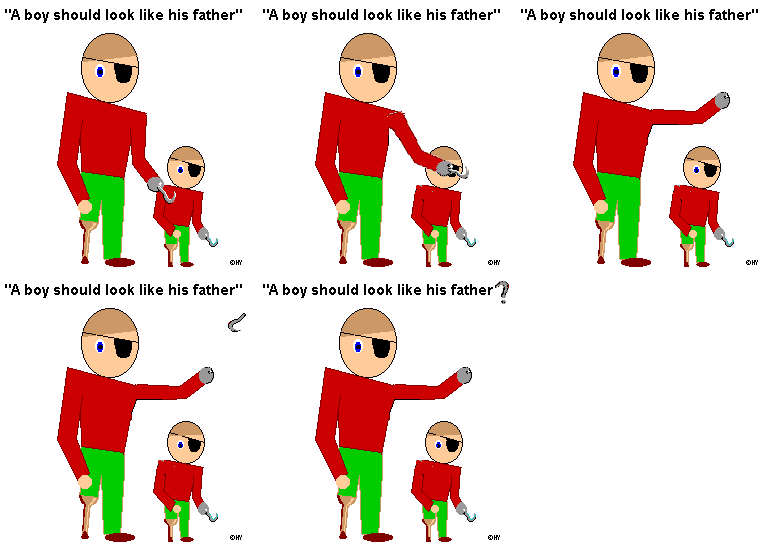
"A boy should look like his father"

"Women prefer circumcised men"

This seems to be spread mainly by women (for a man to say it makes it too clear that it is about his insecurities, not the boy's). There is certainly no clamour from boys demanding to be circumcised for this reason.

This seems to be spread mainly by men (it may be believed by women, whatever they themselves prefer - but women who do themselves prefer circumcised penises are more likely to believe it).

This links to the more general "looking like his father" that assures paternity.

After all, women don't need to be told what women prefer.

It may be that the meme "a boy should look like his father" has a basis in biology:

  • Species that survive, do so because they behave in ways that promote the survival of their own genes
  • Individuals promote the survival of their own offspring and (in the wild) have no interest in the offspring of others (or even a negative interest, as where an incoming alpha male kills the offspring of his predecessor)
  • Appearance is one of the ways individuals recognise their own offspring.
  • A male may be less likely to bond with his son if the appearance of his son's genitals is markedly different from his own. (This fails to explain how he bonds with his daughters, but that may have a quite different mechanism, as the bond is different)
  • The boy's mother may fear that the father will not bond if their appearance is not similar, and collude with making them match.

The question arises, how could circumcision get established if intact fathers risked failing to bond to their circumcised sons?
Answer: In both the mythical (and probably the actual) origins of the religious rite, and the historical origins of the surgical rite, boys out of infancy were circumcised for a generation or more before infants were, so intact fathers had intact sons, who grew up, were circumcised, and became circumcised fathers of sons sons they then had circumcised. So there was no time when many intact fathers had circumcised sons.

How, then, did circumcision come to an end in Britain and New Zealand without demur from the circumcised fathers of intact sons?
A partial answer is that fathers (and mothers) were not consulted. The meme was never given the opportunity to be invoked.

Pirate father - eyepatch, hook, wooden leg - with matching son

The meme "Women prefer circumcised penises" is likely to spread among men wherever a majority of men are circumcised, whether there is any truth to it or not. Women are more likely to say, "I prefer intact/circumcised penises" than to claim to speak for all women - but more likely than either to have no preference, but rather, to judge each man on his personal qualities.

The meme is extremely strong where circumcision is tribal, and hence universal within the tribe, taking the extreme form "No woman will look at a[n intact] man." Women in bars in Samoa are said to check European men out manually before agreeing to go with them.

If women hear the meme, they are likely to assume that men are speaking from experience, not just wishful thinking. If they are smart, they will not hurt circumcised men's vanity by telling them that they have no preference (or actually prefer intact penises). So men's belief in the meme is reinforced and not challenged.

It seems like another reason to circumcise babies, so more babies are likely to be circumcised where it is believed, giving rise to another generation of circumcised men to spread the meme. The Williamsons' study shows that it is widely believed where the great majority of men are circumcised - even by women who have no basis for comparison.

There is no corresponding meme "Women prefer intact penises" in communities (most of the world) where most penises are intact, not because women don't prefer them, but because intactness is spread genetically, not memetically. Intact penises don't need memes to spread, only genes. Circumcision needs memes.

"From now on, I'm thinking only of me."
Major Danby replied indulgently with a superior smile: "But, Yossarian, suppose everyone felt that way."
"Then," said Yossarian, "I'd be a damned fool to feel any other way, wouldn't I?"

- Joseph Heller, Catch-22

This is the principle of "runaway sexual selection": females prefer some characteristic, such as long tail feathers in males, even though - or even because - it puts the males at a disadvantage. If a female tries to buck the trend and mate with a male with short tail feathers, her short-tailed male offspring are less preferred by the next generation and her preference dies out.

In the same way, it makes genetic sense for women to prefer the kind of man (they think) most women prefer.

Female Genital Mutilation:

The meme "A girl should look like her mother" is not greatly recorded in cultures that practise FGM. This is probably because questions of maternity (who the mother is) seldom arise. Nor is there any danger that a girl will not bond with her mother. FGM is generally committed after she has done so.

The meme "Men prefer circumcised women" is very strong in cultures that practise FGM - in fact it takes the extreme form "She must be circumcised or no man will want to marry her." This is probably spread more by women, with men collaborating, not by positively preferring circumcised women in the first instance, but by refusing to take a woman who has placed her suitability in doubt by being rejected by all other men.

Intersexuality::

When a child is born intersexed, their parents and their deliverers are thrown into a panic, because the meme "A human is male or female" is immensely strong, being built into all the memes associated with our sexuality and intimately associated with our genes. What is striking is that the surgical action that is taken in response to that panic has little or no bearing on the child's genes or their reproductive future, but almost entirely on the appearance of their genitals.

The Spanner in the Works

Meanwhile, the irrational aspect to the circumcision memeplex adds a complication. Circumcising a baby is Doing Something (at a particular time and place), so it has a definiteness about it that Leaving The Baby Alone does not. In fact US mothers who leave their babies intact are frequently accused of neglect. Circumcision leaves a vivid mark of having been done. It does not usually do sufficient harm at any one time to be genetically or socially contraindicated - unlike, say, castration. (There is some suggestion that ritual circumcision may have been introduced in Egypt as a substitute for ritual castration - of a priestly caste, rather than the whole male population, obviously.) The good that circumcision supposedly does is set in the unforeseeable future. (In this, circumcision is like those religion memes that promise infinite and eternal rewards or punishments after death.) Since the evils it is supposed to prevent are rare, it is allowed to take credit by default for their absence, something like a lucky charm, or wearing garlic to ward off vampires.

Is this concept productive?

Reviewing a book of Dawkins', Simon Blackburn argues against treating memes as having purposes or designs, which of course they do not. But while they are in people's heads, memes are subjected to those people's purposes and designs, and hence to creative, evolutionary processes. And for memes, acquired characteristics (changes to the meme phenotype between transmissions) ARE inherited, unlike those of genes. (That is, meme evolution is Larmarkian, as well as Darwinian.)

For example, secular circumcision quickly evolved from being a childhood treatment for masturbation to an infant preventative of it, largely because newborns can put up less resistance. (Jewish circumcision probably moved in the same direction in ancient times. Muslim, Korean and Philippine circumcision have yet to do so. They are also reportedly milder than the Jewish and US forms.) And when masturbation hysteria waned, people's wish to circumcise, which is the heart of the circumcision memeplex, has attached and reattached itself to successive diseases it was alleged to prevent.

Intactivism hammering protean circumstitions

The concept of a meme or memeplex is particularly productive with regard to genital mutilation, because the idea of genital mutilation has a coherence of its own that is independent of individual rationality.

Is intactness, then, also a meme?

An intact penis (or female genitalia) are not themselves memes (nor meme-phenotypes), because they are transmitted by genes, not by imitation. In the context of a strongly circumcising culture, it may require unusual determination to break the hold of the circumcision meme, but, for the most part, leaving a baby alone needs no reason.

However, Intactivism, the campaign for genital integrity (which only exists in the context of genitally mutilating cultures), may usefully be considered a memeplex. Here are some of the ideas linked to it:

Intactivism as a meme - linked ideas
The Intactivism Memeplex

Opposition to the three varieties of genital modification has been amalgamated here because most of the associated factors relate to all three, in greater or lesser degree. (The “gender equality” meme is near to male circumcision, but there is a special relationship between feminism and opposition to FGM - women's outrage that this can be done to women. We might speak of “gender solidarity”. Sadly, there seems little or no equivalent men's outrage, based on gender solidarity, that this can be done to fellow men. It seems to be overwhelmed by macho denial of pain, imposed on tiny babies.)

The Intactivism memeplex is clearly much simpler than the circumcision memeplex. The different elements also reinforce each other in ways that the parts of the circumcision memeplex do not. These are two of the strengths by which the Intactivism memeplex will ultimately prevail. Intactivism is an easy idea to transmit, and once transmitted, it is not easily lost.

These practices are memes that have thrived for thousands of years in spite of being so harmful to their carriers. Now that we have the insight and ability to prevent them continuing to replicate, we should work for their complete eradication from the memepool.

http://www.circumstitions.com/meme.html